
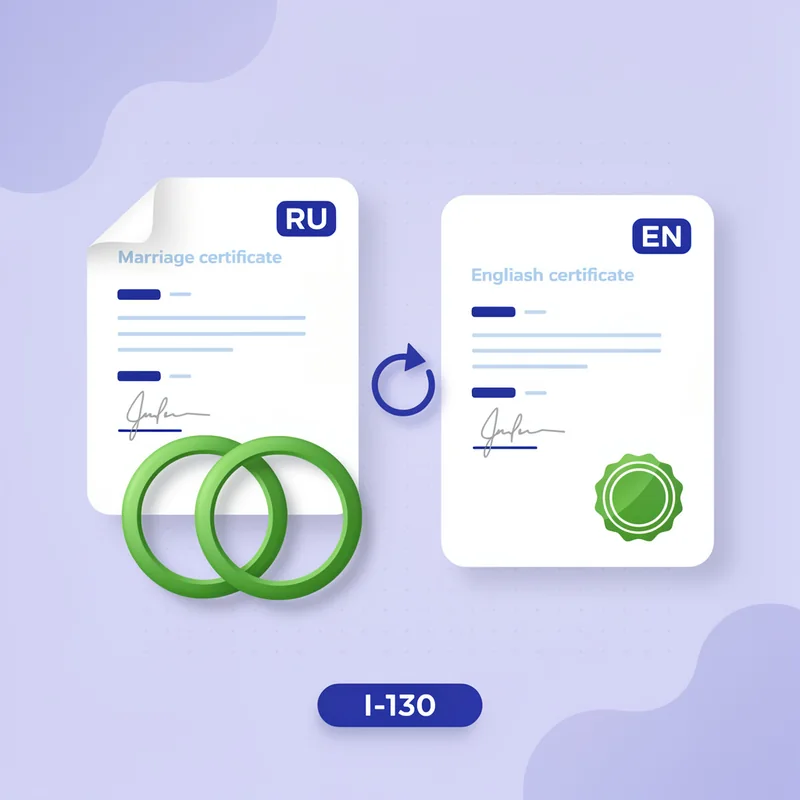
- The marriage certificate is submitted with I-130, again with I-485 or the consular file, and each time it needs a full certified translation under 8 CFR 103.2(b)(3).
- Every prior marriage of both spouses must be shown to have ended, so divorce certificates, court decisions and death certificates are translated alongside the marriage certificate.
- The line recording surnames after the marriage is where name changes are explained; the translation reproduces both names and matches the Latin spelling to your passport.
- The registry entry number connects the marriage certificate to any later divorce record or extract, and is reproduced exactly across the packet.
- Send both sides of every civil document in one order so that names, dates and office names are handled consistently.
Where the marriage certificate sits in a spousal case
In a spousal case the marriage certificate is the document that proves the relationship exists. Form I-130 asks for it as primary evidence; Form I-485 asks for it again when the spouse adjusts status inside the United States; the National Visa Center asks for it once more when the spouse applies at a consulate. A certificate issued in Russia or Ukraine is in Russian or Ukrainian, so at every one of those stages it must be accompanied by a full English translation certified under 8 CFR 103.2(b)(3): complete, accurate, and signed by a translator who states that they are competent to translate.
The translation is usually reused across the stages, so it is worth getting right once. This article walks through what the certificate contains, what other records travel with it, and what tends to raise questions.
Russian and Ukrainian formats
A Russian marriage certificate, свидетельство о заключении брака, is issued by a ZAGS office. Older ones are Soviet booklets; newer ones are single-sheet forms with the coat of arms, a series and number, watermarks and a round seal. The certificate records the full names of both spouses before the marriage, their dates and places of birth, their citizenship, the date of the marriage, the registry entry number and date, the surnames the spouses carry after the marriage, the office, the issue date, and the signature of the head of the office.
A Ukrainian certificate, свідоцтво про шлюб, has the same content. Forms from the 1990s and 2000s are often bilingual, Ukrainian and Russian, issued by a RATsS office; forms from around 2015 onward are Ukrainian only, issued by a DRATsS office and printed from the electronic registry. Either country may also issue an extract from the registry instead of a certificate when the original is lost. An extract is translated as an extract, and it carries the same registry entry number, so it can be matched with any earlier certificate.
- Both spouses' names before the marriage, with patronymics.
- The surnames after the marriage, one line for each spouse.
- The date of the marriage and the date of registration, which are usually the same, but not always.
- The registry entry number, the office name and the seal text.
- The series and number of the form, transliterated so that it can be matched to the original.
Prior marriages: the records that go with the certificate
USCIS asks both spouses to show that every earlier marriage ended before the current one began. The petitioner's prior marriages and the beneficiary's prior marriages are treated the same way, and each termination needs a document.
- 1A divorce certificate from ZAGS or DRATsS. In Russia and Ukraine the divorce is complete when it is registered by the civil registry and a certificate is issued, whether the divorce started at the registry or in court.
- 2The court decision on divorce, if the certificate was issued on its basis and the decision contains information the certificate does not, such as the date the decision entered into force.
- 3A death certificate, if a previous spouse died.
- 4An annulment decision, in the rare cases where a marriage was declared invalid.
Each of these documents is translated in full and certified separately. The dates must line up: the divorce registration must precede the new marriage, and where a court decision and a certificate both exist, the officer will look for the date that made the divorce final. If a previous marriage was registered in a third country, that record is translated from its own language.
Name change after marriage
The line reading surname after the marriage is where most name questions begin. A spouse who took the other's surname may still hold a foreign passport in the previous name, or a passport already reissued in the new name, and the U.S. documents may show either. The translation reproduces both surnames exactly as the certificate gives them and transliterates them to match the passport you send us.
If the spelling on your passport differs from what a mechanical transliteration of the certificate would produce, for instance Yulia on the passport and Iuliia by the current Russian standard, your translator uses the passport form and adds a note. If the two spouses have different transliteration conventions, each name follows its own passport. What we do not do is decide a name for you; if your passport was never updated, the translation shows the surname change as recorded and the rest is a question for your attorney and the passport office.
Registry numbers, stamps and the back page
The registry entry number (запись акта in Russian, актовий запис in Ukrainian) is the identifier of the marriage in the civil registry, and it appears on every later document about the same marriage: the divorce certificate, an extract, a court decision. Your translator reproduces it exactly and keeps the same format across the packet, so the reader can trace one marriage through several documents.
Stamps and seals are translated, including the office seal on the certificate, an apostille sticker if you have one, a stamp confirming that a passport was reissued in the new surname, and any handwritten registry note. The reverse of the certificate is photographed and translated, or the translation states that it is blank. A translation that stops at the front of the certificate is not complete, and completeness is the first thing the certification promises.
Mistakes that hold up spousal files
- Front side only. The stamped back of a Soviet booklet or an apostille sheet is missing, and the certification says complete when it is not.
- Three spellings of one name. The marriage certificate, the birth certificate and the divorce certificate were translated by different people, and the petitioner's or beneficiary's name is spelled differently on each.
- A missing termination record. Only the current marriage certificate is submitted, and the form's answer that a spouse was married before has no document behind it.
- Dates in the wrong format. A day-first date is copied as month-first, and a marriage registered on 05.03.2010 appears to have taken place in May instead of March.
- A summary instead of a translation. The English gives the names and the date and skips the office, the registry number and the seal.
All five are avoidable with one habit: send every civil document in the case, both sides, to one translator, in one order, with the passport spellings attached.
How to order
- 1Photograph the marriage certificate, front and back, and every prior-marriage record for both spouses.
- 2Upload them together, choose Russian or Ukrainian to English, and tell us the translation is for a spousal petition.
- 3Attach the passport name pages of both spouses or type the spellings you already use with USCIS.
- 4Approve the price: from $23.70 per document, certification included. A single-sheet certificate with a blank reverse is usually the minimum; the blank side is not counted.
- 5Receive one PDF per document, each with the translation, the signed certificate of accuracy and a copy of the original, ready to attach to I-130, I-485 or the consular file.
FAQ
Can I use the same translation for I-130 and later for I-485?
Yes, if the document has not changed and the translator's signed certification is still attached. Keep the PDF we deliver and submit the same file at each stage; that also keeps the spelling of the names identical across the case.
My marriage was registered in Russia, but my spouse's earlier divorce was in Ukraine. Is that two translations?
Yes, each document is translated from its own language and certified on its own. We handle both language pairs in one order, so the names, dates and office names are rendered consistently across the two documents.
Do I need to translate a divorce decree issued by a U.S. court?
No. Documents already in English do not need translation. Only the foreign-language records in the case, such as a Russian or Ukrainian marriage, divorce or death certificate, need a certified English translation.
If you need your documents translated, always work with a certified translator.
POVO translates Russian and Ukrainian documents into English, with a signed certificate of accuracy. Upload the document, see the price and the date, pay when you are ready.