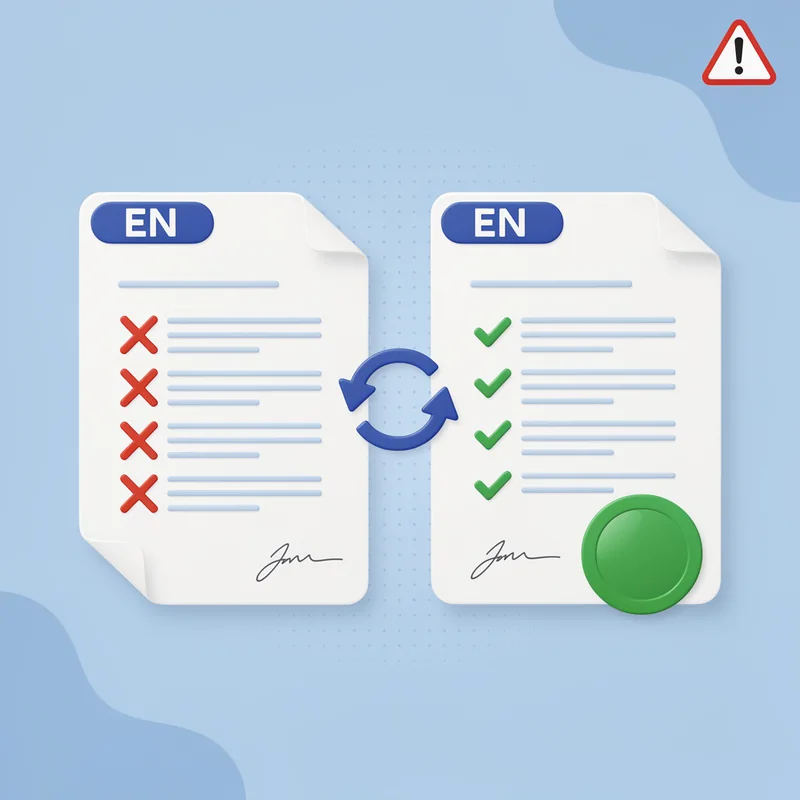

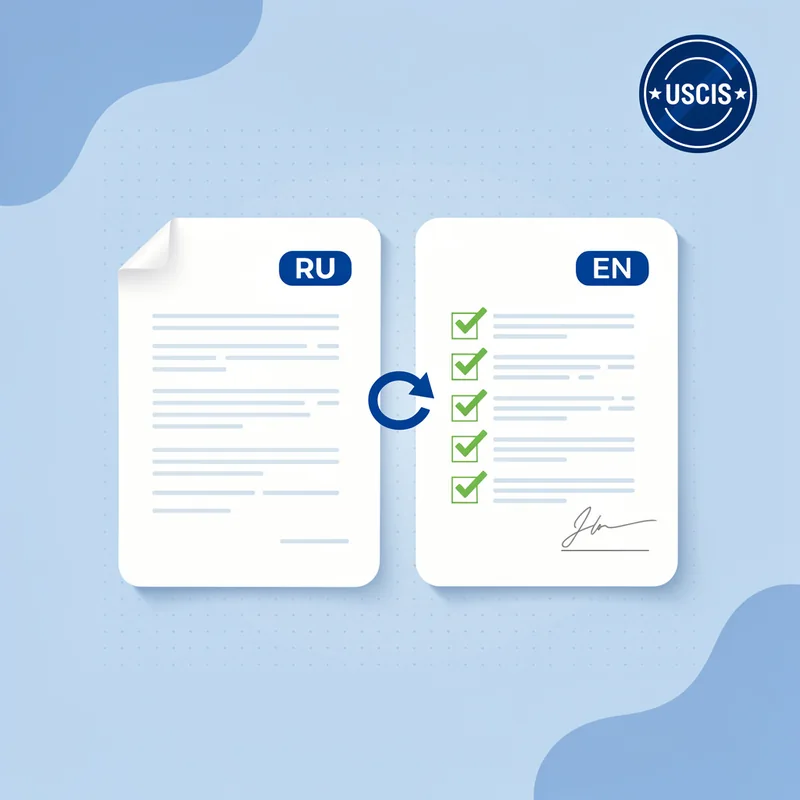
- USCIS requires a full English translation of every foreign-language document plus a signed certification from the translator, under 8 CFR 103.2(b)(3).
- The certification must state that the translation is complete and accurate and that the translator is competent in both languages.
- Notarization is not required by USCIS; a certified translation is enough unless a specific form instruction says otherwise.
- Everything on the page counts: stamps, seals, handwritten notes, and the back side must be translated or marked.
- Most translation problems surface as a Request for Evidence, which stops your case until you fix and resubmit.
What the USCIS rule actually says
The requirement lives in one short regulation, 8 CFR 103.2(b)(3). It says that any document in a foreign language submitted to USCIS must be accompanied by a full English translation, and that the translator must certify that the translation is complete and accurate and that they are competent to translate from that language into English. That is the whole rule. There is no list of approved agencies, no license number, and no notary stamp in the text.
In practice, the officer reviewing your file expects two things stapled together: the English translation of the document and a certification page signed by the person who translated it. Most filers also include a copy of the original, so the officer can compare the two side by side. When we prepare a translation for USCIS, the copy of your original, the translation, and the certification go out as one set.
Full translation means everything on the page
The most common misunderstanding is that only the important fields need to be in English. USCIS reads the word full literally. A Russian or Ukrainian birth certificate is not just a name and a date. It also has a series and number, the registration office, the registrar's signature, a round seal, and often stamps on the back side about citizenship, apostille, or a later name change.
- Every stamp and seal, transcribed as text and marked, for example [round seal: Civil Registry Office, Leninsky District, Moscow].
- Every handwritten note, including corrections made by the registry.
- The back side of the document, even when it looks like a blank page with one stamp.
- Serial numbers, form numbers, and printed footers, because the officer uses them to match the translation to the copy.
- Illegible text, marked as [illegible] rather than silently skipped.
A summary or extract translation, along the lines of the document confirms that the applicant was born on a certain date, does not meet the standard. Neither does a partial translation that covers the front and skips the back. If the officer sees a stamp on your copy that has no counterpart in the translation, the translation is treated as incomplete.
What the certification statement must contain
The certification is a short signed statement, usually on the last page of the translation or on a separate sheet. USCIS does not prescribe the wording, but the statement has to cover the two points in the regulation: completeness and accuracy, and the translator's competence. A working certification includes:
- 1A sentence that the translator is competent to translate from Russian (or Ukrainian) into English.
- 2A sentence that the attached translation is a complete and accurate translation of the named document.
- 3The name of the document translated, for example Birth Certificate, series and number.
- 4The translator's full name, signature, and the date of signing.
- 5Contact details, such as an address, phone number, or email, so USCIS can reach the translator if needed.
Who may certify a translation for USCIS
The regulation says the translator, not a court-sworn translator, a member of a professional association, or a licensed agency. Any person who is fluent in both languages can translate and sign the certification. That includes a friend, a coworker, or a professional service. Two practical limits apply.
First, you should not translate your own documents. Nothing in the rule forbids it, but the officer is weighing evidence, and a certification signed by the applicant about the applicant's own birth certificate carries little weight. The same caution applies to a spouse petitioning for you or a close relative whose case depends on the outcome. Second, the translator has to stand behind the work. If USCIS has doubts, it can ask for a new translation or for proof of the translator's competence. A translation from a service that puts its name, address, and contact details on the certification is easier for the officer to accept and easier for you to defend later.
Notarization is not required
Many applicants arrive with the idea that a USCIS translation must be notarized. It does not. A notary in the United States only confirms that the person who signed the certification is who they say they are. The notary does not read Russian or Ukrainian and cannot vouch for the translation itself. That is why the regulation asks for the translator's certification and says nothing about a notary.
Notarization becomes relevant in other settings: some courts, some state agencies, and foreign consulates may ask for it. For a USCIS filing, adding a notary stamp does no harm, but it does not replace the certification, and paying for it is usually unnecessary. If a specific form instruction or an RFE letter asks for a notarized translation, follow that letter, and tell your translator so the certification can be signed in front of a notary.
Formatting the officer expects
USCIS does not publish a template, but officers compare the translation to the copy of the original line by line. A translation that mirrors the layout of the original makes that comparison fast and reduces questions. Your translator should keep the same order of fields, reproduce tables as tables, and place bracketed descriptions of seals and stamps where they appear on the page.
- Names are transliterated the way they appear in the person's foreign passport, and the same spelling is used in every document in the packet.
- Dates are written out in a format that cannot be misread, such as 14 March 1989, instead of 14.03.1989 or 03/14/1989.
- Place names follow current official English spelling, with the historical name kept in brackets when the document uses it, for example Kyiv (Kiev) or Saint Petersburg (Leningrad).
- Nothing is added, explained, or corrected. If the original contains a typo, the translation reproduces it and may note it in brackets.
Common reasons translations get sent back
A translation problem usually shows up as a Request for Evidence rather than a denial. The RFE stops the clock while you fix the problem and resubmit, and the wait can run for months. The issues we see most often are:
- No translation at all for a document the filer assumed was self-explanatory, such as a passport stamp, a Ukrainian ID card, or a bilingual Soviet-era certificate.
- A translation without a certification page, or a certification with no signature or date.
- A partial translation that skips the back side, an apostille sheet, or a stamp.
- A translation made from a blurry photo where the seal or a number cannot be read, and the translator guessed.
- Names spelled one way on the birth certificate translation and another way on the marriage certificate translation.
- A machine translation pasted into a document with a certification statement added on top.
Each of these is avoidable. Before you order, do four things:
- 1Scan or photograph every page, including the back, at a resolution where the smallest stamp text is readable.
- 2Write down the Latin spelling of every name in the packet, as printed in the foreign passport, and send it with the scans.
- 3Keep all documents for one case with one translator so spelling and terminology stay consistent.
- 4Keep the originals. USCIS asks for copies with the translation and may ask to see the original at an interview.
Read the translation against the original before filing. You know your own dates and names better than anyone, and a quick check catches errors before the officer does.
FAQ
Does USCIS require the translation to be done by a certified translator?
No. The rule requires the translator to certify the translation, not to hold a certification. Any competent bilingual person can sign, though a professional service with contact details on the certification is easier for the officer to accept.
Am I allowed to translate my own paperwork for USCIS?
The regulation does not forbid it, but an officer gives little weight to a certification signed by the applicant. Use an independent translator, especially for civil documents that prove identity or family relationships.
Do I need to send the original document with the translation?
Usually a clear copy of the original is enough, filed together with the translation and certification. Keep the original; USCIS may ask to see it at an interview.
If you need your documents translated, always work with a certified translator.
POVO translates Russian and Ukrainian documents into English, with a signed certificate of accuracy. Upload the document, see the price and the date, pay when you are ready.