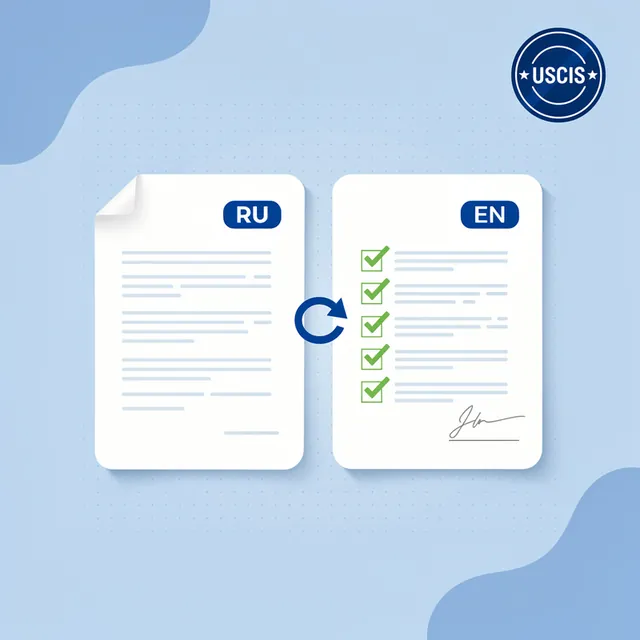

- USCIS requires a full English translation of any document containing a foreign language, with a certification from the translator.
- A certified copy of the adoption or custody decree, with a certified translation, is listed as evidence in orphan cases. A copy of the adoption decree is listed for family-based petitions and citizenship evidence.
- The certification must say the translation is complete and accurate and that the translator is competent to translate from the foreign language into English.
- The certification must also include the translator's signature, printed name, signature date and contact information.
- A complete decree translation reproduces every page, stamp, seal, date and handwritten note.
USCIS requires a full English translation of any document that contains a foreign language. The translator must certify that the translation is complete and accurate and that the translator is competent to translate from the foreign language into English. In an adoption case this applies to the adoption decree and to supporting records such as the child's birth certificate.
Which adoption documents does USCIS ask for?
The list depends on the type of case. For an orphan petition (Form I-600), USCIS lists these items, among others:
- Proof of the child's age and identity.
- Evidence that the child is an orphan as defined in INA section 101(b)(1)(F) and 8 CFR 204.3(b).
- Copies of the death certificates of the child's prior legal parents, if applicable.
- A certified copy of the adoption or legal custody decree, and a certified translation.
- A copy of the marriage certificate and proof that any previous marriages ended, if applicable.
For a Form I-130 filed for an adopted child, USCIS lists a copy of the adoption decree showing the adoption took place before the child turned 16 (or 18 if the sibling exception applies). It also lists evidence of 2 years of legal custody and 2 years of joint residence.
USCIS also addresses citizenship. If the adopted child has not received a Certificate of Citizenship, the other proof of acquisition of citizenship includes a certified copy of the final adoption decree, with a translation if it is not in English.
What must the certified translation include?
- A full English translation of each document that contains a foreign language.
- A translator's certification that the translation is complete and accurate.
- A statement that the translator is competent to translate from the foreign language into English.
- The translator's signature, printed name, the signature date and the translator's contact information.
The translation accompanies the document. The rule calls for a full English translation of the document, not a summary of it.
What is on a Russian or Ukrainian adoption decree?
An adoption decree from a court is a multi-part document. A complete certified translation reproduces all of it:
- The name of the court, the case number, the date of the decision, and the judge's name and signature.
- Every stamp and seal, including any stamp or note about the decision entering into legal force, with its date.
- The child's full name, date of birth and place of birth, and the new name if the adoption changed it.
- The names of the adoptive parents and, where the decree lists them, the birth parents.
- Handwritten notes and corrections. Parts that cannot be read are marked as illegible, not guessed.
Dates matter in these cases. For a Form I-130, USCIS asks for a decree showing that the adoption took place before the child turned 16 (or 18 if the sibling exception applies). A decree may show a decision date and a later date when it took legal effect. Both dates are translated exactly as written, with the month spelled out so that day and month cannot be confused.
Which other records are translated with the decree?
- The child's birth certificate. For Form I-600, USCIS asks for a copy of the birth certificate, or an explanation with other proof of age and identity if it is not available. If a certificate was reissued after the adoption, the original and the new one are separate documents, each with its own translation.
- Death certificates of the child's prior legal parents, if applicable.
- Documents showing legal custody or an irrevocable release of the child for emigration and adoption, where they are part of the file.
- The adoptive parents' marriage certificate and any divorce or death records that end earlier marriages, when they are in Russian or Ukrainian.
When a birth certificate is not available, USCIS names medical records, school records, religious records, orphanage intake sheets and affidavits among the possible secondary evidence. Any document containing Russian or Ukrainian text is submitted with a full certified translation.
How are names spelled in the translation?
Names of the child and the parents are spelled the same way in every document of the case. Where an international passport exists, the spelling follows the passport. If the adoption changed the child's name, the translation shows the name as written in the decree and the name as written in the new birth certificate, so the link between the two is clear. USCIS lists an adoption decree among the legal documents that reflect a name change.
How is a decree translation prepared and checked?
- 1Every page of the decree is read, including the reverse side and attached sheets.
- 2All text is translated, including stamps, seals, headings, marginal notes and handwritten entries.
- 3Names, dates, case numbers and other numbers are compared with the original and with the passport.
- 4The certification is added with the required elements: accuracy statement, competence statement, signature, printed name, date and contact information.
- 5The translation and a copy of the original are combined so the reviewer can compare them page by page.
How POVO translates adoption documents
Russian and Ukrainian into English, every page and stamp, names as in the passport, signed certification, one PDF, $23.70 minimum per document.
FAQ
Does an adoption decree translation need a certification?
USCIS requires a foreign-language document to be accompanied by a full English translation and a certification from the translator. The certification covers completeness, accuracy and the translator's competence to translate from the foreign language into English.
Which details must the translator's certification show?
It must state that the translation is complete and accurate and that the translator is competent to translate from the foreign language into English. It must also include the translator's signature, printed name, signature date and contact information.
Does Form I-130 for an adopted child list the adoption decree?
Yes. USCIS lists a copy of the adoption decree showing the adoption took place before the child turned 16, or 18 if the sibling exception applies. If the decree is in Russian or Ukrainian, the translation requirement above applies to it.
Is the adoption decree listed as citizenship evidence?
USCIS says that if the child has not received a Certificate of Citizenship, other proof of acquisition of citizenship includes a certified copy of the final adoption decree, with a translation if it is not in English.
Are the child's birth certificate and a parent's death certificate translated too?
They are listed as evidence in orphan cases. USCIS lists proof of the child's age and identity and copies of the death certificates of the child's prior legal parents, if applicable. A document containing Russian or Ukrainian text must be accompanied by a full certified English translation.
Official sources
Links open the original publications this article restates.
- USCIS, I-600, Petition to Classify Orphan as an Immediate Relativeuscis.gov
- USCIS, Instructions for Petition to Classify Orphan as an Immediate Relative (Form I-600)uscis.gov
- USCIS, I-130, Petition for Alien Relativeuscis.gov
- USCIS, Form I-130 and I-130A Instructionsuscis.gov
- USCIS, U.S. Citizenship for an Adopted Childuscis.gov
- eCFR, 8 CFR 103.2, Submission and adjudication of benefit requestsecfr.gov
Documents from this article that POVO translates
- Birth certificate: $35 per document
- Diploma: $25 per page
- Passport: $25 per filled page, no more than $150 per document
If you need your documents translated, always work with a certified translator.
POVO translates Russian and Ukrainian documents into English, with a signed certificate of accuracy. Upload the document, see the price and the date, pay when you are ready.