
- An apostille confirms the signature and seal on a public document; it does not confirm the content and it is not a translation.
- USCIS does not require apostilles on foreign civil documents; a complete certified English translation is what the regulation asks for.
- Courts, some universities and licensing boards, state agencies and foreign institutions may require one, so check the receiving office's own instructions.
- An apostille can only be issued in the country that issued the document; get it before translation so the apostille page is translated too.
- The apostille page is translated as part of the document, with no extra charge for the apostille and certification included.
What an apostille is, and what it is not
An apostille is a standardized certificate attached to a public document by an authority in the country that issued it. It confirms that the signature, the capacity of the person who signed, and the seal on the document are genuine. Countries that joined the 1961 Hague Convention accept each other's apostilles instead of a chain of consular legalizations. Russia, Ukraine and the United States are all members.
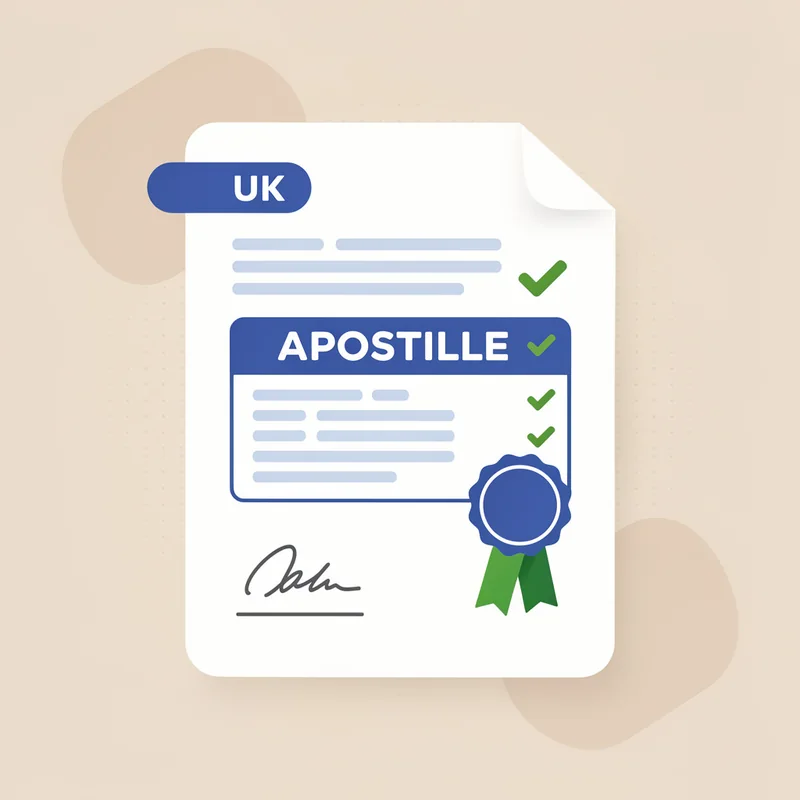
An apostille does not confirm that the content of the document is true, and it does not translate anything. It is a stamp or a stapled sheet with ten numbered fields under the heading Apostille (Convention de La Haye du 5 octobre 1961): the country, who signed the document and in what capacity, which seal it bears, and where, when, by whom and under what number the apostille was issued. In Russia it is usually a stamp on the document or on a sheet sewn to it; in Ukraine it is more often a separate attached sheet.
Does USCIS need an apostille? Usually not
For immigration filings the answer is almost always no. The USCIS regulation on foreign language documents asks for a full English translation with the translator's certification of completeness, accuracy and competence. It does not ask for an apostille on birth, marriage, divorce or police documents. For forms such as I-130, I-485, I-765 and N-400, a clear copy of the original and a certified translation are the standard package.
Confusion comes from two places. An officer can request additional verification of a document if there are doubts about it, and some applicants add an apostille in advance. That is a personal choice, not a requirement. If you already have an apostille on a document, include it and have it translated. If you do not, do not delay a filing to get one unless the form instructions or a request from USCIS says so.
Who does ask for an apostille
Outside immigration, each receiving institution sets its own rules. These are the ones that most often ask:
- Courts. A foreign public document offered as evidence in a US court usually needs authentication, and an apostille is the standard way to provide it for documents from Hague countries. Divorce decrees, judgments and notarized powers of attorney are typical.
- Universities, licensing boards and some credential evaluators. Many evaluation services accept copies with a certified translation and do not require an apostille, but some universities, medical and engineering boards, and bar admissions do. Read the requirements for your program or board before you order anything.
- State agencies. A DMV, a vital records office or a county clerk may ask for an apostilled birth or marriage certificate for a name change, a REAL ID application or a marriage license. Practice varies by state and by office.
- Consulates and foreign institutions. A Russian or Ukrainian document used in a third country, or a US document used in Russia or Ukraine, usually needs an apostille from the issuing country. A US document gets its apostille from the Secretary of State of the issuing state, not from a consulate.
The rule of thumb: only the institution that will receive the document can tell you whether it needs an apostille. Ask in writing and keep the answer.
Where apostilles are issued in Russia, by document type
An apostille is issued only in the country that issued the document, by the authority responsible for that type of document. It cannot be obtained at a Russian consulate in the United States. If you are already in the USA, a relative or a representative with a notarized power of attorney can apply for you.
- Civil status certificates (birth, marriage, divorce, death, change of name): the civil registry authority (ZAGS) of the region where the certificate was issued.
- Education documents (diplomas, diploma supplements, school certificates): the regional education authority of the region where the school or university is located.
- Notarized documents, court decisions, powers of attorney and notarized copies: the territorial office of the Ministry of Justice for the region.
- Police clearance certificates: the information center of the Ministry of Internal Affairs that issued the certificate; the certificate and the apostille can often be requested together.
- Archive extracts and archive certificates: the regional archive authority.
A practical warning: ZAGS offices commonly refuse to apostille a laminated certificate, because the seal and signature cannot be verified through the film, and many Soviet-era certificates are laminated. The fix is to request a duplicate certificate from the same office, then apostille the duplicate. Soviet-era documents are apostilled by the authority of the country where the issuing office is located today, so a birth certificate issued in Soviet Ukraine is apostilled in Ukraine, not in Russia.
Where apostilles are issued in Ukraine, by document type
Ukraine centralizes apostilles in three ministries, with applications accepted through their territorial departments, civil registry offices and, for education documents, the ministry's information center. Ukrainian consulates in the USA do not issue apostilles either, so a relative with a power of attorney is the usual route.
- Civil status documents (birth, marriage, divorce, death, change of name), court decisions, notarized documents and registry extracts: the Ministry of Justice, with applications through its regional departments and through civil registry (DRATsS) offices.
- Diplomas, diploma supplements, transcripts, school certificates and other education documents: the Ministry of Education and Science.
- Everything else, including police clearance certificates, medical certificates, archive documents and documents issued by other state bodies: the Ministry of Foreign Affairs.
Ukrainian apostilles issued in recent years can be checked online by number, and some receiving institutions in the USA do that. Keep the apostille sheet attached to the document; a detached sheet loses its value.
Translating the apostille itself
Once an apostille is attached, it is part of the document, and a full translation includes it. The apostille is printed in Russian or Ukrainian with the French heading required by the Convention, and its ten fields are translated like any other page: the issuing authority, the name and position of the person who signed the underlying document, the seal, the place, the date, the apostille number and the signature block. If the apostille sits on the back of the certificate, that back page is photographed and translated with the front.
The order matters. Get the apostille first, then order the translation, so the translation covers the apostille. If you translate first and apostille later, the apostille page will need a short second translation. Apostilles are not charged extra, and certification is included.
Do not apostille the translation. An apostille certifies the signatures of public officials in the issuing country. A translator's certification made in the United States is not a Russian or Ukrainian public document, and a US apostille on it only matters if the translation is going abroad.
A short decision path
- 1Ask the receiving institution whether it requires an apostille. For USCIS the answer is no unless you are told otherwise.
- 2If yes, identify the issuing authority for that document type in Russia or Ukraine and arrange the application, in person or by power of attorney.
- 3If the certificate is laminated or damaged, request a duplicate first.
- 4Photograph the document with the apostille attached, front and back.
- 5Order the certified translation of the whole set, apostille included.
FAQ
Can I get an apostille for my Russian birth certificate at the consulate in the USA?
No. Apostilles are issued only inside the issuing country by the authority responsible for that document type. A relative or a representative with a power of attorney can apply on your behalf.
Does my certified translation need its own apostille?
Not for use in the United States. USCIS and US institutions rely on the translator's signed certification. An apostille on a translation only comes up when the translation will be used in another country.
My document was translated before the apostille was added. What now?
Send us the apostille page. It is translated as a one-page addition and attached to the existing translation with its own certification, so the set stays complete.
If you need your documents translated, always work with a certified translator.
POVO translates Russian and Ukrainian documents into English, with a signed certificate of accuracy. Upload the document, see the price and the date, pay when you are ready.