
- For extraordinary ability, 8 CFR 204.5(h)(3)(viii) lists evidence of a leading or critical role for organizations or establishments that have a distinguished reputation.
- The USCIS Policy Manual says letters from people with personal knowledge of the role can be particularly helpful when they contain detailed and probative information on how the role was leading or critical.
- Under 8 CFR 204.5(g)(1), evidence of qualifying experience or training takes the form of letters that show the writer's name, address and title, and a specific description of the duties performed.
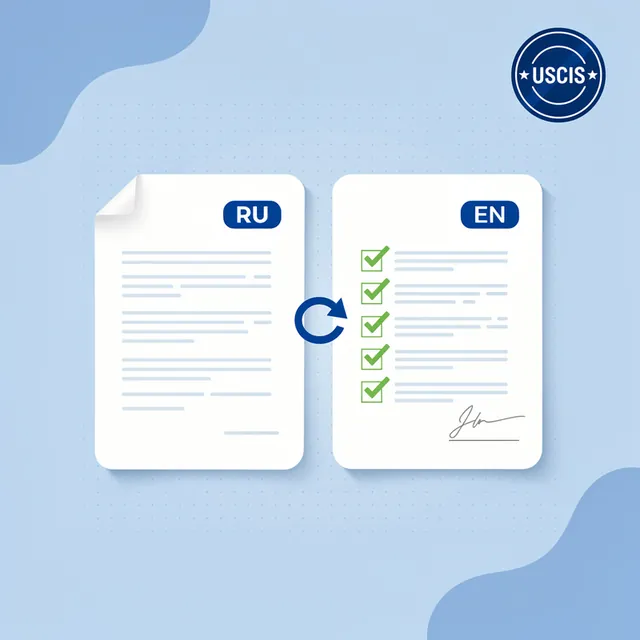
- A letter in Russian or Ukrainian needs a full English translation with the translator's signed certification.
- The translated letter keeps its own date. The certification has a separate signature date.
For the extraordinary ability category, the USCIS Policy Manual says letters from people with personal knowledge of a leading or critical role can be particularly helpful when they contain detailed and probative information on how the role was leading or critical. A letter in Russian or Ukrainian must be accompanied by a full English translation that the translator has certified as complete and accurate. The translation reproduces the letter's date, writer details, stamps and signature as they appear on the original.
Which USCIS rule asks for evidence of a critical role?
The regulation lists evidence that the person has performed in a leading or critical role for organizations or establishments that have a distinguished reputation. This is one of the criteria in 8 CFR 204.5(h)(3) for the extraordinary ability classification.
The USCIS Policy Manual explains it in two steps. First, USCIS determines whether the person has performed in a leading or critical role for an organization, an establishment, or a division or department of one. Second, USCIS determines whether that organization, establishment, department or division has a distinguished reputation.
What does the Policy Manual say about the content of such a letter?
These points come from the Policy Manual and concern the content of the original letter:
- Letters from persons with personal knowledge of the significance of the person's role can be particularly helpful.
- The letters should contain detailed and probative information that specifically addresses how the role was leading or critical.
- A title, with appropriate matching duties, can help to establish that a role was leading.
- For a critical role, officers look at whether the evidence shows the person contributed in a way that is of significant importance to the outcome of the organization's activities.
- It is not the title of the role, but the person's performance in the role, that determines whether it was critical.
Separately, 8 CFR 204.5(g)(1) says evidence relating to qualifying experience or training is in the form of letters from current or former employers or trainers. These letters include the name, address and title of the writer, and a specific description of the duties performed.
How do the date and the period of the role appear?
The Policy Manual speaks of a role that is (or was) leading or critical. A letter can therefore describe a current role or a past one. It also states that evidence of experience must consist of letters from employers.
On the original letter, the date of issue and the dates of the role are ordinary text. A complete translation keeps every one of these dates, including the issue date next to the signature.
Russian and Ukrainian letters often write dates as day, month, year with dots, such as 05.03.2025. A translator can write the month in words so the date reads clearly in English, without changing it.
Does the translation certification have its own date?
Yes. The USCIS instructions for Form I-140 say the translator must sign a certification that the English translation is complete and accurate and that the translator is competent to translate from the foreign language into English. The certification must also include the translator's signature, printed name, the signature date and contact information.
So a translated letter carries two dates: the date of the letter itself and the date the translator signed the certification. They are different, and neither replaces the other.
The certification can name the document it covers, so it is clear which letter it belongs to.
What on the original letter must the translation reproduce?
8 CFR 103.2(b)(3) requires a full English translation of any document containing foreign language. For a letter confirming a role, a complete translation includes:
- The letterhead: organization name, address, telephone, email, registration or outgoing number.
- The date of the letter and any dates of employment or service in the text.
- The writer's full name, position and contact details.
- The full body, including the description of duties, projects, awards and the organization's activities.
- Every signature, marked as a handwritten signature, and any initials.
- Round or rectangular stamps and seals, with their text translated and their location described.
- Handwritten notes, corrections and any notary marks or apostille.
- Names of people and organizations spelled consistently with the person's passport and other documents.
What does USCIS say about copies of the letter?
8 CFR 204.5(g)(1) states that, in general, ordinary legible photocopies of supporting documents are acceptable for initial filing. At the director's discretion, original documents may be required in individual cases.
A legible copy shows the stamps, signature and handwriting clearly, so the translation can describe each of them.
How POVO translates a letter confirming a critical role
Russian and Ukrainian into English, every page and stamp, names as in the passport, signed certification, one PDF, $23.70 minimum per document.
FAQ
Does the translation reproduce the letterhead of the original letter?
Yes. If the original letter has a letterhead, the translation reproduces it, along with the organization name, address, contact details and any outgoing number.
Who can write a letter about a leading or critical role?
The Policy Manual says letters from persons with personal knowledge of the significance of the person's role can be particularly helpful, as long as they contain detailed and probative information on how the role was leading or critical.
Does the translation of the letter need its own certification date?
Yes. The USCIS instructions for Form I-140 say the translator's certification includes the translator's signature, printed name, signature date and contact information.
Can the translator shorten the letter?
No. 8 CFR 103.2(b)(3) requires a full English translation that the translator has certified as complete and accurate. A complete translation covers the whole letter, including stamps, signatures and notes.
Are the role and the organization's reputation evaluated separately?
According to the Policy Manual, USCIS first determines whether the person performed in a leading or critical role. It then determines whether the organization, establishment, department or division has a distinguished reputation.
Official sources
Links open the original publications this article restates.
Documents from this article that POVO translates
- Birth certificate: $35 per document
- Diploma: $25 per page
- Passport: $25 per filled page, no more than $150 per document
If you need your documents translated, always work with a certified translator.
POVO translates Russian and Ukrainian documents into English, with a signed certificate of accuracy. Upload the document, see the price and the date, pay when you are ready.