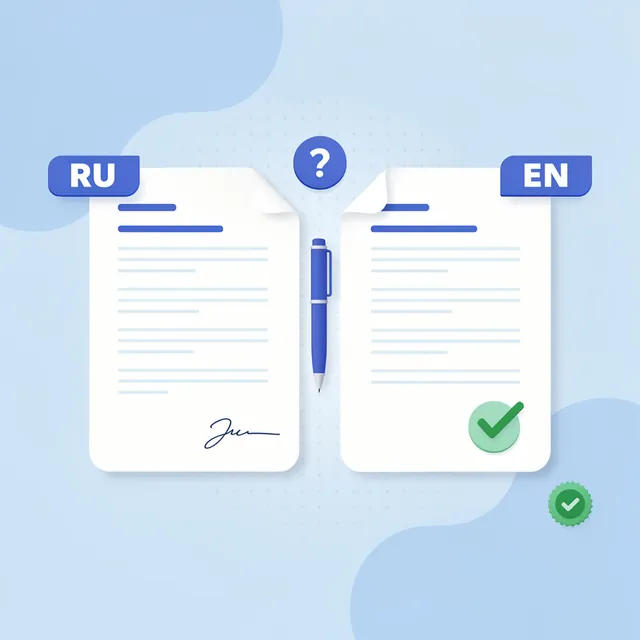

- Any document containing a foreign language that is submitted to USCIS needs a full English translation, certified as complete and accurate, with the translator's certification of competence.
- For EB-1A published material, the evidence must include the title, date and author of the material, and any necessary translation.
- For an advanced degree in EB-2, USCIS describes the evidence as an official academic record, so the diploma and its grade pages are translated in full.
- USCIS says letters should describe the contribution and set out the basis of the writer's knowledge and expertise, so the translation keeps the writer's title and credentials.
- Every stamp, seal, signature and handwritten note on the original appears in the English text.
USCIS requires a full English translation of every document containing a foreign language. The translator must certify the translation as complete and accurate, and must certify that he or she is competent to translate from the foreign language into English. In EB-1A, O-1 and EB-2 NIW evidence, this covers publications, diplomas, awards and letters. Each one is translated in full, with all stamps, signatures and publication details.
What does USCIS require for translated evidence in these petitions?
The translation rule is in 8 CFR 103.2(b)(3). It applies to any document containing foreign language submitted to USCIS. The translation must be full, the translator must certify it as complete and accurate, and the translator must certify competence to translate from the foreign language into English.
A summary, an excerpt or a few translated lines is not a full translation. The English document follows the original page by page.
What differs between the petitions is the kind of evidence. The translation rule does not change.
- EB-1A: at least 3 of 10 listed criteria, or evidence of a one-time achievement.
- O-1A: initial evidence of a major, internationally recognized award, or evidence that satisfies at least 3 of 8 criteria.
- EB-2 exceptional ability: documentation that meets at least 3 of 6 criteria. A person seeking a national interest waiver may self-petition, without an employer sponsor.
How are Russian and Ukrainian publications translated?
For published material about a person, the EB-1A evidence must include the title, date and author of the material, and any necessary translation. The O-1A criterion uses the same wording.
USCIS lists print or online newspaper and magazine articles, popular or academic journal articles, books, textbooks, similar publications, and transcripts of professional or major audio or video coverage as possible evidence. Each of these has its own details to carry over.
- Name of the publication, as printed on the masthead or website header.
- Headline, subheadings and the author's byline. If there is no byline, the translation shows none.
- Publication date, issue number and page numbers.
- Photo captions, pull quotes and sidebars.
- For video or audio coverage: the transcript and its full English translation, with speakers identified as in the transcript.
Online articles often include a web address, a date stamp and reader comments. The translator reproduces what appears on the printout or screenshot and does not add details that are not there. Names of people and places follow the spelling in the passport or other official record.
How are diplomas and academic records translated?
For an advanced degree professional, USCIS describes the evidence as an official academic record showing a U.S. advanced degree or a foreign equivalent degree. If a doctoral degree is customarily required, the record must show a U.S. doctorate or foreign equivalent degree. For exceptional ability, one listed criterion is an official academic record showing a degree, diploma, certificate or similar award relating to the area of exceptional ability.
A Russian or Ukrainian diploma usually comes with an insert listing subjects, hours and grades. The front page and the insert are translated together. The translation keeps:
- The name of the university, faculty and specialty.
- The qualification or degree title exactly as written, such as a specialist, master's or candidate of sciences degree.
- The diploma number, registration number and dates of issue and of the commission's decision.
- Every subject, grade and credit entry on the insert.
- Seals, the rector's or dean's signature and any handwritten entries.
The translator renders the degree title in English words and does not name a U.S. equivalent.
How are awards and certificates translated?
For prizes and awards, USCIS determines whether the person received the prize or award. The focus is on the person's receipt, not the employer's receipt. The translation shows the recipient's name as spelled in the passport.
For O-1A, USCIS lists these considerations for awards: the criteria used to grant the award, its national or international significance in the field, the number of awardees, and limitations on eligible competitors. Award regulations, competition rules and winner lists can carry this information. Where they are part of the evidence, they are translated in full.
For awards, the translation reproduces the name of the awarding body, the title of the prize, the date, the grounds for the award and any signatures and seals. A certificate with a printed ornamental border and a handwritten name is translated with the handwritten part marked as handwritten.
How are recommendation and expert letters translated?
USCIS says submitted letters should specifically describe the person's contribution and its significance to the field, and should set forth the basis of the writer's knowledge and expertise. Detailed letters from experts can provide context, particularly when the record includes documents corroborating the claimed significance.
A letter from a Russian or Ukrainian professor, director or employer is translated from the letterhead to the signature. That includes the writer's title, institution, contact details, date, outgoing number, stamp and signature.
For an advanced degree professional with a bachelor's degree, USCIS lists letters from current or former employers showing at least 5 years of progressive post-bachelor's work experience in the specialty. For the exceptional ability criterion on experience, USCIS lists letters showing at least 10 years of full-time experience in the occupation. Such letters are translated the same way.
Other supporting papers follow the same approach. For the O-1A criterion on judging the work of others, USCIS gives as an example a request from a journal to do a review, accompanied by evidence confirming that the review was completed.
What must the certification show?
The certification is the translator's signed statement. The regulation in 8 CFR 103.2(b)(3) calls for two things:
- 1A certification that the English translation is complete and accurate.
- 2A certification that the translator is competent to translate from the foreign language into English.
A POVO certification for Russian or Ukrainian documents also carries the translator's name, signature and date, and lists each document it covers, so the certification matches the pages it accompanies.
How POVO translates evidence for EB-1A, O-1 and NIW
Russian and Ukrainian into English, every page and stamp, names as in the passport, signed certification, one PDF, $23.70 minimum per document.
FAQ
Does USCIS accept a partial translation of an article?
The regulation asks for a full English language translation of any document containing foreign language. The translation therefore covers the whole article, including the headline, byline and date.
What details of a publication must appear in English?
For EB-1A published material, the evidence must include the title, date and author of the material, and any necessary translation. A complete translation also shows the publication name and page or issue details.
Is a diploma insert translated together with the diploma?
USCIS describes the evidence of a degree as an official academic record. The diploma and the insert with subjects and grades are translated in full, so the record is complete.
Do letters from Russian or Ukrainian experts need a full translation?
Yes, the whole letter is translated, because it is a document containing foreign language under 8 CFR 103.2(b)(3). USCIS says letters should set forth the basis of the writer's knowledge and expertise. The writer's title and credentials are therefore kept in the English text.
Is the translation rule different for O-1 than for EB-1A?
The certified translation requirement in 8 CFR 103.2(b)(3) applies to any document containing foreign language submitted to USCIS. The O-1A published material criterion also includes the title, date, author and any necessary translation. The evidence categories differ between the petitions.
Official sources
Links open the original publications this article restates.
- eCFR, 8 CFR Part 103, Immigration Benefit Requests (section 103.2(b)(3), Translations)ecfr.gov
- USCIS Policy Manual, Volume 6, Part F, Chapter 2 - Extraordinary Abilityuscis.gov
- USCIS Policy Manual, Volume 6, Part F, Chapter 5 - Advanced Degree or Exceptional Abilityuscis.gov
- USCIS, Employment-Based Immigration: First Preference EB-1uscis.gov
- USCIS, Employment-Based Immigration: Second Preference EB-2uscis.gov
- USCIS Policy Manual, Volume 2, Part M, Chapter 4 - O-1 Beneficiariesuscis.gov
- USCIS, Nonimmigrant or Parole Pathways for Entrepreneur Employment in the United States (O-1A)uscis.gov
Documents from this article that POVO translates
- Diploma: $25 per page
- Transcript / diploma supplement: $25 per page
If you need your documents translated, always work with a certified translator.
POVO translates Russian and Ukrainian documents into English, with a signed certificate of accuracy. Upload the document, see the price and the date, pay when you are ready.