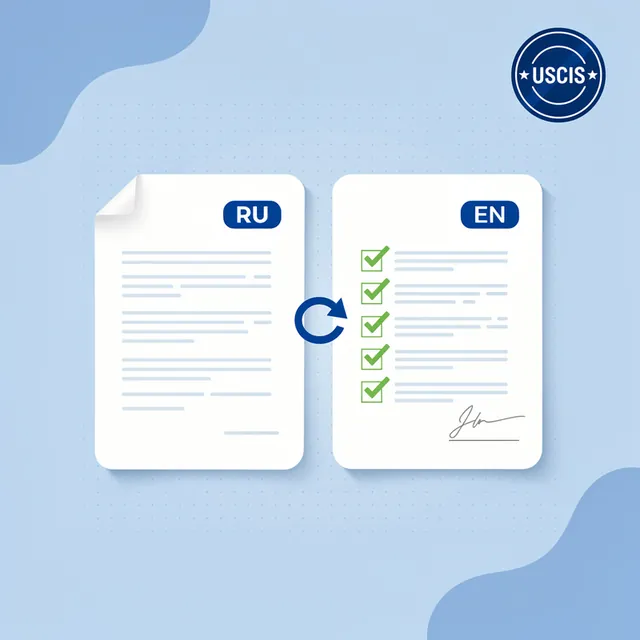

- In the United States a certified translation is a complete English translation plus the translator's signed statement of accuracy and competence. No government license or seal is involved.
- USCIS requires it for every foreign-language document under 8 CFR 103.2(b)(3). Courts, universities, and employers use the same format.
- The certificate must say the translation is complete and accurate and that the translator is competent in both languages, with name, signature, and date.
- You do not need to visit an office: a clear photo or scan of the document is enough for most receiving offices.
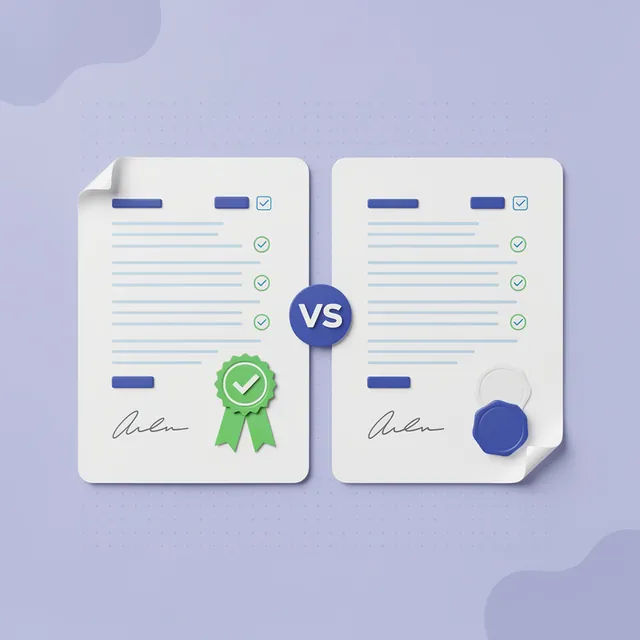
- Order only what the receiving office asks for. Notarization and apostille are separate things and are usually not required.
To get a certified translation, you send a photo or scan of the document to a translator, who returns the complete English translation with a signed statement that it is complete and accurate and that the translator is competent in both languages. No license, seal or notary is involved; USCIS requires this format under 8 CFR 103.2(b)(3).
What a certified translation is
A certified translation is the full English text of your document together with a statement signed by the translator. The statement confirms that the translation is complete and accurate and that the translator is competent to translate from the original language into English. That is the whole definition. There is no federal registry of translators, no sworn translator status, and no official seal in the United States. The certification is the translator taking personal responsibility for the work.
The wording comes from the federal rule that governs filings with USCIS, 8 CFR 103.2(b)(3): any document containing foreign language submitted to USCIS shall be accompanied by a full English language translation which the translator has certified as complete and accurate, and by the translator's certification that he or she is competent to translate from the foreign language into English. Immigration courts apply a similar rule in 8 CFR 1003.33, and most universities, employers, and state agencies accept the same format.
Who can certify a translation
The rule speaks of the translator, not of a company or a licensed professional. Any person who is competent in both languages may sign the certification. In practice, receiving offices expect the certification to come from someone who is not a party to the case: an applicant translating their own birth certificate can create doubt about accuracy, and USCIS may respond with a Request for Evidence. A professional translator or a translation service removes that doubt and puts a name and contact details behind the statement.
Membership in a professional association such as the American Translators Association is not required by the regulation. What matters is the content of the statement and that the translation is complete, including stamps, seals, handwritten notes, and the back side of the document.
What the certification must say
- A statement that the translation is complete and accurate.
- A statement that the translator is competent to translate from the source language into English.
- The translator's full name, signature, and the date of signing.
- Contact information of the translator or the translation service, so the receiving office can verify the statement.
- A reference to the document translated: type of document, names, and the language of the original.
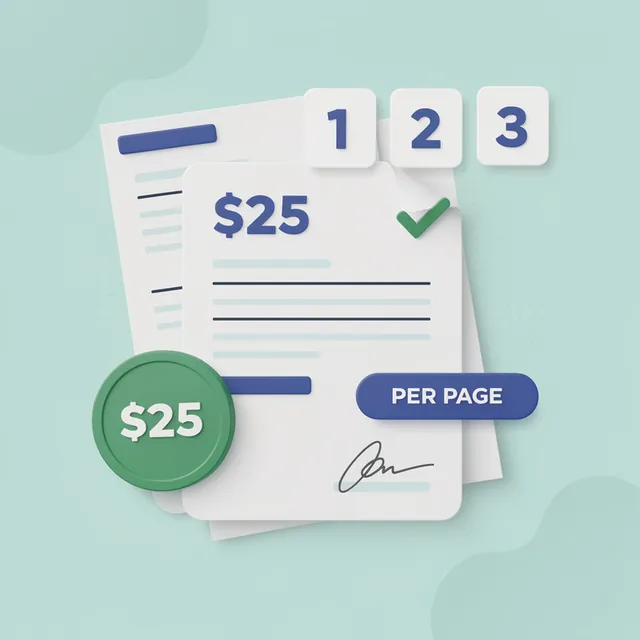
At POVO the certificate of accuracy is a separate page attached to every translation. It includes all five elements above and is signed by the translator who did the work. The price, from $23.70 per document, includes this page.
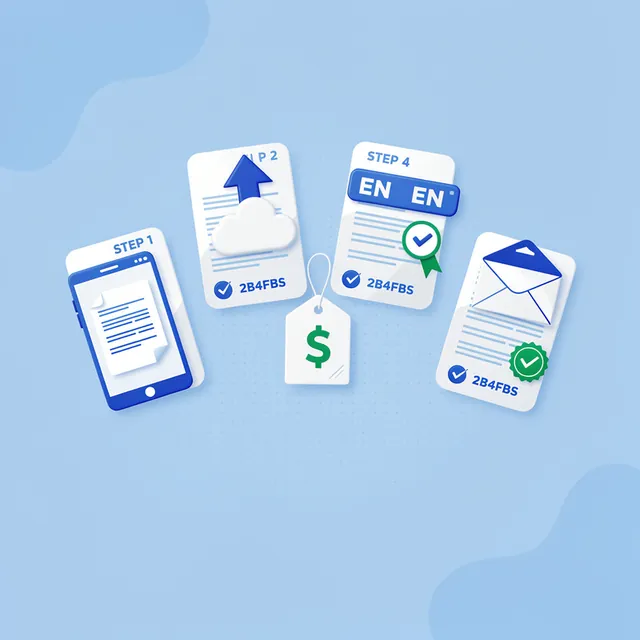
Step 1: find out what the receiving office wants
Before ordering, check the instructions of the office that will receive the document. USCIS wants a certified translation only. Some courts and some foreign consulates ask for notarization, which is a different step. Universities and credential evaluators such as WES or ECE have their own submission rules. Ordering exactly what is required saves money and avoids a returned packet.
Step 2: prepare the document
A clear photograph or scan of every page, including the back if it has stamps or notes, is enough. The translation is made from the image, and the certified file refers to the document, not to the physical paper. If the document is in a booklet, such as a Soviet-era birth certificate or a work record book, photograph every filled page. Our guide on photographing documents explains how to avoid glare and cut-off edges.
Step 3: upload and see the price
At POVO you upload the file on the website and the price appears right away, before you pay. The price is per document, not per word, so a one-page certificate and a two-page certificate with an apostille sheet are quoted as what they are. You can see the quote without creating an account.
Step 4: translation and certification
A translator competent in Russian or Ukrainian and English translates the full text, including every stamp and seal, and keeps the layout close to the original so the receiving officer can match the two side by side. Names are transliterated to match the spelling in your passport, because a mismatch between documents is a common reason for a Request for Evidence. The translator then signs and dates the certificate of accuracy.
Step 5: receive the file and submit it
You receive a PDF with the translation and the signed certificate by email, most often on the next business day. For online USCIS filings the PDF is uploaded as is. For paper filings you print it and place it behind a copy of the original. Keep the PDF: the same certified translation can be reused in later filings as long as the original document has not changed.
What you usually do not need
Notarization adds a notary who confirms the translator's identity; it does not check the translation and USCIS does not ask for it. An apostille authenticates the original document for use in another country and is issued by the country that issued the document; it is not a translation and USCIS does not require it on foreign civil documents. If an office asks for either one, it will say so in its instructions.
FAQ
Can I translate my own document and certify it?
The regulation does not forbid it, but USCIS officers may question a translation certified by the applicant or a family member, and a Request for Evidence costs weeks. Most applicants use an independent translator for this reason.
Does the translator have to be ATA-certified?
No. 8 CFR 103.2(b)(3) requires a statement of competence and accuracy from the translator, not membership in any association.
Does a certified translation need to be notarized for USCIS?
No. USCIS asks for a certified translation only. Notarization is a separate step that some courts or consulates may request.
How long does a certified translation take?
At POVO most single documents are delivered on the next business day. Larger sets of documents take longer, and the time is shown with the quote.
Can I get a certified translation online?
Yes. You upload a photo or scan, see the price, pay, and receive a PDF with the signed certificate by email. No office visit is needed.
Official sources
Links open the original publications this article restates.
If you need your documents translated, always work with a certified translator.
POVO translates Russian and Ukrainian documents into English, with a signed certificate of accuracy. Upload the document, see the price and the date, pay when you are ready.