
- USCIS, SSA and the State Department match documents by name and date of birth; a different spelling of the same name across documents is a common reason for questions.
- The translator transliterates names as they appear in the person's current foreign passport, not according to a dictionary or a personal preference.
- Russia and Ukraine use different official transliteration systems, and both have changed over the years; the same name can have several "correct" Latin spellings.
- When a document predates the passport and the person's name was spelled differently, the translation follows the passport and may note the variant in brackets.
- Place names follow current official English spelling with the document's form in brackets.
Why spelling matters
An officer compares the name on the translated birth certificate with the name on the passport, the visa, the I-94 and the forms. "Yevgeniy", "Evgeny" and "Evgenii" are the same Russian name, but to a database they are three different people. The result is not a rejection but a question, a Request for Evidence or a delay while the officer confirms that the documents belong to one person.
Which spelling the translator uses
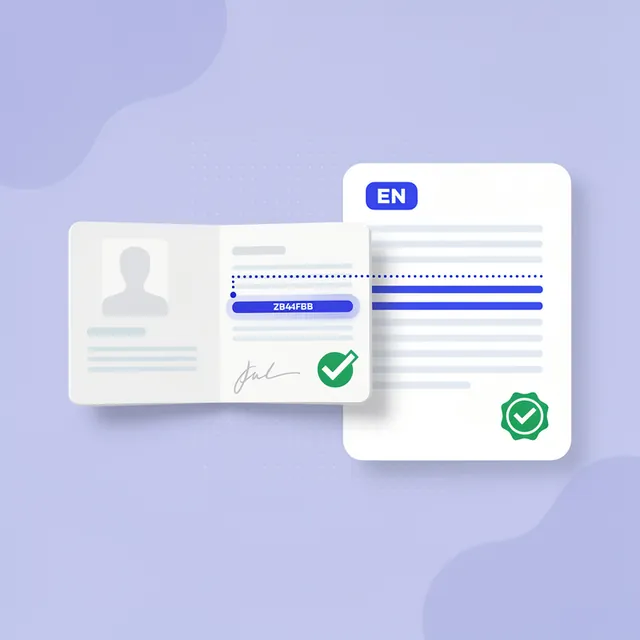
The rule we apply, and the one most USCIS-focused translators apply, is simple: the Latin spelling of a person's name follows that person's valid foreign passport. The passport is the identity document the officer already has in the file. If the applicant has no foreign passport, the spelling follows another official document already submitted in Latin script, such as a visa or a previously issued translation, and stays the same throughout the packet.
Russian and Ukrainian systems
- Russia has changed passport transliteration several times; passports issued at different times spell "Ю" as "YU" or "IU", "Я" as "YA" or "IA", "Й" as "Y" or "I". A person's old and new passports can disagree.
- Ukraine's official transliteration (Cabinet of Ministers Resolution No. 55 of 2010) spells "Ї" as "YI" or "I", "Є" as "YE" or "IE", "Г" as "H". Ukrainian passports follow it; older Soviet-era documents in Russian do not.
- A Ukrainian-born person whose birth certificate is in Russian and whose passport is Ukrainian will have the Russian form of the name in the document and the Ukrainian form in the passport, for example Николай / Mykola.
How the translation handles differences
- The name is written as in the passport.
- When the document itself uses a clearly different form, the translation reproduces the document's form and adds the passport spelling in brackets, so the officer sees both.
- Patronymics are transliterated the same way in every document in the file.
- A name change by marriage or by a formal change-of-name record is documented separately; the translation does not "fix" the name.
Place names
Cities and regions are written in current official English spelling, with the document's form in brackets where it differs: Kyiv (Kiev), Kharkiv (Kharkov), Saint Petersburg (Leningrad). The translator does not modernize the document; the bracket shows the reader what the original says.
What we do
Before translating, we ask for a photo of the passport page with the Latin spelling and use it for every document in the order. All documents in one order are checked against each other so that names, patronymics and places match.
FAQ
My old visa spells my name differently from my new passport. Which one do I use?
The valid passport. Mention the earlier spelling to your attorney or on the form where prior names are asked.
Can I ask the translator to use the spelling I prefer?
The translation should match the identity document, not a preference; a different spelling creates a mismatch in the file.
My child's birth certificate is in Ukrainian and my passport is Russian. How is the surname spelled?
The child's name follows the child's passport if there is one; otherwise it follows the parent's passport spelling for the shared surname, with the document's form in brackets.
Do you translate the name or transliterate it?
Names are transliterated, never translated: Вера stays Vera, not Faith.
Official sources
Links open the original publications this article restates.
If you need your documents translated, always work with a certified translator.
POVO translates Russian and Ukrainian documents into English, with a signed certificate of accuracy. Upload the document, see the price and the date, pay when you are ready.