
- Only pages with text, stamps or stickers are translated and charged; blank pages are listed as blank at no cost.
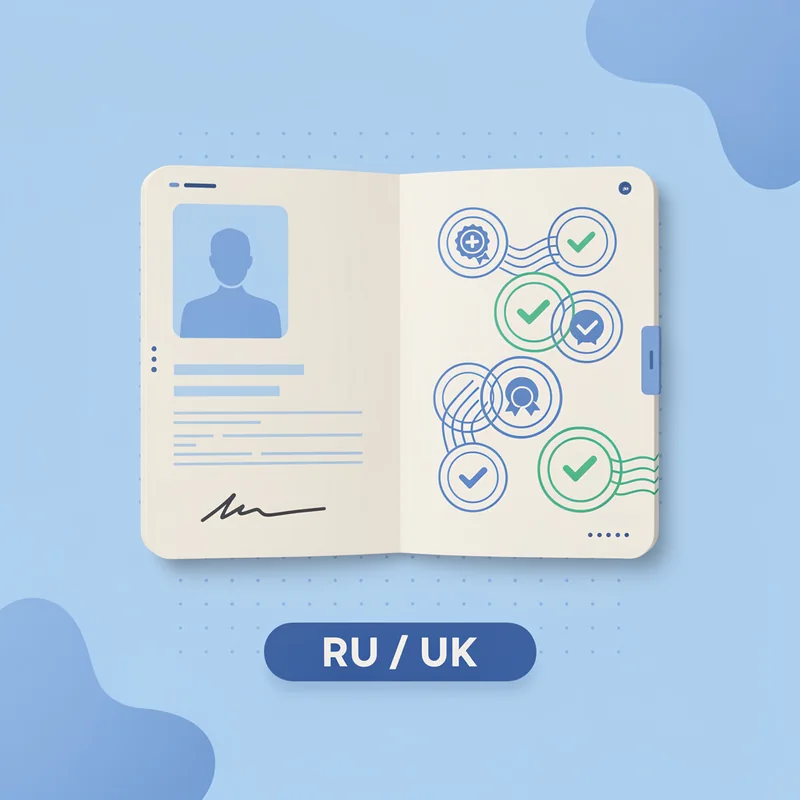
- The foreign passport's data page is bilingual, so the real work is in the visas, stamps and handwritten notes.
- The Russian internal passport holds the registration, marital status and children entries that USCIS forms ask about.
- The Ukrainian ID card carries no stamps; address history comes from the separate register extract.
- The Latin spelling in your current foreign passport is the spelling used across all your translations.
A passport is the first document most people think of translating and the one most often translated wrong: either every blank page is sent and charged, or the stamps that matter are left out. Which pages you need depends on which passport you mean and on what the receiving office is checking. Here is how we sort it for USCIS filings, court cases and employers.
Two different documents called a passport
Russian and Ukrainian citizens usually hold two: the foreign, or travel, passport used to cross borders, and the internal passport or ID card used at home. In Russia the internal document is a booklet. In Ukraine it is the plastic ID card issued since 2016, or the older booklet for people who have not replaced it. The foreign passport is what USCIS treats as your passport. The internal document comes up when an officer needs address history, marital status or children, because that is where those entries live.
The two are translated differently. The foreign passport is bilingual on its data page, so the work is in the visas, stamps and notes. The internal document is rarely bilingual, so every page with an entry is translated in full.
The foreign passport: data page, visas and stamps
The data page of a Russian or Ukrainian foreign passport is printed in the national language and English. Your name, date of birth, passport number and dates are already readable, but the issuing authority line and some field labels are not, and an office that asked for a passport translation expects the data page in the file. We translate it in full so the certified document stands on its own.
The pages that carry real information for an immigration case are the ones with entries: visa stickers with their annotations, entry and exit stamps with dates and border points, and handwritten notes. USCIS forms ask about your trips, your last entry and your prior visas, and the officer checks those answers against the stamps. Each stamp is translated with its date in the US format and the border point named as printed.
- Data page: all fields, including the issuing authority and the field labels
- Visa pages: visa type, number, validity dates, annotations, the issuing post
- Stamps: entry or exit, date, border crossing, any handwritten additions
- Notes pages: children entered, former surname, cancellations and corrections
Older Russian foreign passports list children on an inside page, and some passports carry a note about a former surname. Those entries connect to birth and marriage certificates and are translated for that reason. Expired passports are translated the same way when they show earlier travel or a maiden name, with the expiry date as printed.
Blank pages: not translated, not charged
USCIS asks that every foreign-language document you submit be accompanied by a full English translation. It does not ask you to submit blank pages, and a blank page has nothing to translate. So the price works like this: it is based on the words in your document; stamps, seals and stickers are not charged extra; blank pages are listed in the translation as blank and cost nothing. A passport with a data page and four stamped pages is priced on the text of those five pages, not on all thirty, and a short document like this is usually the $23.70 minimum.
Send all pages anyway, including the blank ones, in one set of photos. Your translator needs to see them to state which pages were blank, and the certificate of accuracy then covers the whole booklet. The page count is shown with your quote before you pay, and if the count turns out lower after we open the files, the quote goes down.
The Russian internal passport: registration, marital status, children
The Russian internal passport has a data page and then a series of pages that stay blank until an office stamps them. USCIS forms ask for your addresses over the last five years, your marital history and your children, and the internal passport is where all three were recorded. These are the pages that matter:
- Pages 2 and 3: personal data, photo, issuing authority and its division code
- Registration pages: each stamp with the address and the registration or deregistration date
- Military duty page: the enlistment office stamp, if any
- Marital status pages: marriage and divorce stamps with the registry office and the date
- Children page: names and dates of birth of the children entered
- Previously issued passports page: numbers and dates of older documents
Cancelled stamps and corrections are translated or described, not skipped, because an officer comparing addresses on your forms will see them in the original. Blank pages are listed as blank, and the count covers only the pages with entries.
The Ukrainian ID card and the residence extract
The Ukrainian ID card has no room for stamps. The card itself is one page with both sides: name, date and place of birth, document number, the issuing authority code and the validity date. Your registered address is not on the card. It is stored in the register and shown on a separate extract from the territorial community register, or on the paper insert issued with early cards. If an office needs your address history, that extract is the document to translate, and it counts as its own page.
Older Ukrainian passport booklets are handled like the Russian internal passport: data page, registration stamps, marital status, children and any notes, with blank pages listed and not charged. Bilingual Ukrainian and Russian forms in those booklets are translated from the Ukrainian side, with the Russian side noted.
The Latin spelling on your passport is the source of truth
Your name in the translation is spelled the way it appears in the Latin line of your current foreign passport. Not the way you write it in email, not the older transliteration, not the version on a diploma issued years ago. USCIS, courts and employers match documents by that spelling, and a birth certificate translated with a different spelling than the passport creates a question you then have to answer in writing.
Russian and Ukrainian transliteration rules have changed more than once, so an older passport, a visa or a US document may carry a different version of the same name. In that case the translation uses the current passport spelling and adds a translator's note with the other version, so the reader can see both and understand why they differ. Tell us the spelling when you order; do not assume we will guess the same way.
- Current passport spelling: used everywhere in the translation
- Older or different spelling on another document: shown in a translator's note
- Patronymics: translated as part of the name, not dropped
- Name changes: the certificate that explains the change is translated as a separate document
How to send the passport for translation
- 1Photograph every page of the passport in order, including blank ones, with the whole page in the frame.
- 2Add the internal passport pages, or the ID card and its extract, if the office needs address or family history.
- 3Type the Latin spelling of your name exactly as it appears on the data page.
- 4Tell us who the translation is for: USCIS, a court or an employer.
- 5Check the page count and the delivery date on the quote before you pay.
You receive one PDF with the translation, the signed certificate of accuracy and a copy of the original pages, ready to attach to your filing. A data page with a few stamped pages is usually ready the next business day, and the date is confirmed before you pay.
FAQ
Do I need to translate an expired passport?
If it shows travel, a visa or a maiden name that matters to your case, yes. It is translated the same way, with the expiry date as printed and the older name spelling noted.
Should I send the blank pages?
Yes, in the same set of photos. They are not charged, but your translator needs to see them to list them as blank so the certified file is complete.
What if my old passport spells my name differently?
The translation uses the spelling in your current passport and adds a note with the older version, so both are visible to the reader and the difference is explained.
If you need your documents translated, always work with a certified translator.
POVO translates Russian and Ukrainian documents into English, with a signed certificate of accuracy. Upload the document, see the price and the date, pay when you are ready.