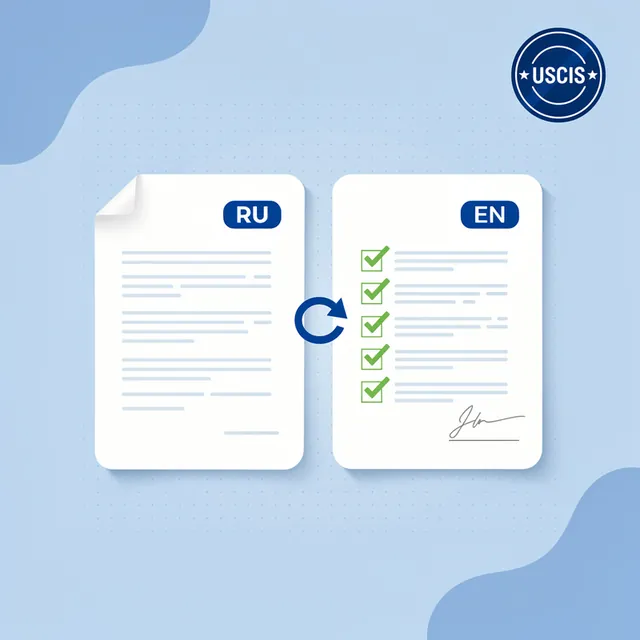

- 8 CFR 103.2(b)(3) requires a full English translation of any document containing foreign language submitted to USCIS.
- The translator must certify that the translation is complete and accurate, and that they are competent to translate from the foreign language into English.
- For a spouse petition, USCIS lists documentation showing joint ownership of property among the evidence of a bona fide marriage.
- For Form I-864 assets, supporting evidence must establish location, ownership, date of acquisition and value of real estate, and evidence of any liens or liabilities must also be provided.
- A complete translation covers notary notes, stamps, seals, registry marks and handwritten entries, not only the main text.
USCIS requires a full English translation of any document containing foreign language. The translator must certify the translation as complete and accurate, and must certify that they are competent to translate from the foreign language into English. This applies to a marriage contract, a property title, a purchase agreement or an ownership extract. A complete translation reproduces every page, stamp, notary note and handwritten entry.
Why do these documents come up in US immigration cases?
Property papers are not USCIS forms. USCIS names property documentation as supporting evidence in some situations.
For a spouse petition, USCIS lists documentation showing joint ownership of property among the evidence of the bona fides of the marriage. The same list appears in the instructions for Form I-130. The USCIS Policy Manual lists it for spousal petitions and for petitions to remove conditions on residence.
For the Affidavit of Support (Form I-864), the instructions allow the value of assets to be submitted if total household income does not meet the requirement. Evidence of those assets is then part of the form package.
What does the translation rule require?
The rule is in 8 CFR 103.2(b)(3). The translation must be full, and it must come with the translator's certification of completeness and accuracy and of competence to translate from the foreign language into English.
The Department of State sets a similar requirement for immigrant visa cases. Documents not in English must be accompanied by certified translations. The translation must include a statement signed by the translator that the translation is accurate and that the translator is competent to translate.
A full translation reproduces the text of the document. A short description such as "agreement on property of spouses" is not a full translation of every clause.
What is on a typical marriage contract or property document?
These documents carry more than body text. A complete translation reproduces each of the following elements, where the original has them.
- Title, date and place of signing, and the full names of both parties as written in their passports.
- Every numbered clause, including lists of items, shares, addresses and sums of money.
- Notary certification text, the notary's name, registry number and seal.
- Round and rectangular stamps from registries, tax offices or other bodies, with their wording and dates.
- Handwritten entries, such as dates, amounts or corrections, marked as handwritten in the translation.
- Signatures, marked as "signature" with the signer's name, and any initials on each page.
- Attached pages: floor plans, lists of property, annexes and amendments.
Illegible or partly covered text is marked as such, for example "[illegible]" or "[stamp partially legible]". It is not guessed or left out.
Which property papers are translated?
Property papers in Russian or Ukrainian that appear in a case include, for example:
- A title certificate or an extract from a property register.
- A purchase and sale agreement or a gift agreement.
- A mortgage or loan agreement tied to a property.
- A vehicle registration certificate, where the vehicle is an asset in the case.
Each of these is translated as its own document with its own certification that identifies the document.
How does property evidence work for Form I-864?
The Form I-864 instructions say that if total household income does not meet the requirement, the sponsor may submit evidence of the value of assets. Supporting evidence must establish location, ownership, date of acquisition and value of any real estate holding. Evidence of any liens or liabilities against these assets must also be provided.
The instructions say that to include the net value of a home, the sponsor must include documentation that shows ownership, a recent appraisal by a licensed appraiser, and evidence of the amount of any loans secured by a mortgage, trust deed or other lien on the home.
When one of these papers is in Russian or Ukrainian, the English version shows the same data as the original: the address, the owner's name, the dates and the amounts.
How should the finished translation look?
- 1The English text follows the order and layout of the original, page by page.
- 2Names match the passport spelling, so the contract, the passport and the application agree.
- 3Dates, numbers, currency names and addresses are copied exactly. Currency is not converted.
- 4Stamps, seals and notes are described in brackets, with their text translated.
- 5The certification is signed and dated, and it states that the translation is complete and accurate and that the translator is competent to translate from the foreign language into English.
- 6The translation accompanies a copy of the original document.
How POVO translates prenuptial and property documents
Russian and Ukrainian into English, every page and stamp, names as in the passport, signed certification, one PDF, $23.70 minimum per document.
FAQ
Does USCIS accept a summary of a marriage contract?
The regulation at 8 CFR 103.2(b)(3) requires a full English translation, certified by the translator as complete and accurate. A summary is not a full translation.
Do I need to translate the whole property document or only one page?
The regulation refers to any document containing foreign language and requires a full English translation of it. A full translation covers annexes, stamps and notary notes that contain foreign language.
Why does USCIS mention property documents for a marriage case?
The I-130 page and the Policy Manual list documentation showing joint ownership of property among the evidence of a bona fide marriage.
Does the translator have to be a professional?
The regulation requires the translator's certification that they are competent to translate from the foreign language into English.
Which documents does the Department of State require translated?
For immigrant visas, the Department of State says documents not in English must be accompanied by certified translations, with a statement signed by the translator that the translation is accurate and the translator is competent to translate.
Official sources
Links open the original publications this article restates.
- USCIS, I-130, Petition for Alien Relativeuscis.gov
- eCFR, 8 CFR Part 103 (section 103.2, Submission and adjudication of benefit requests)ecfr.gov
- USCIS, Form I-864 Instructions for Affidavit of Support Under Section 213A of the INAuscis.gov
- USCIS Policy Manual, Volume 6, Part B, Chapter 6 - Spousesuscis.gov
- USCIS Policy Manual, Volume 6, Part I, Chapter 3 - Petition to Remove Conditions on Residenceuscis.gov
- U.S. Department of State, Immigrant Visa Process, Step 7: Collect Civil Documentstravel.state.gov
Documents from this article that POVO translates
- Birth certificate: $35 per document
- Diploma: $25 per page
- Passport: $25 per filled page, no more than $150 per document
If you need your documents translated, always work with a certified translator.
POVO translates Russian and Ukrainian documents into English, with a signed certificate of accuracy. Upload the document, see the price and the date, pay when you are ready.