
- Every foreign-language item in an asylum file needs a complete English translation and a signed translator's certification, under 8 CFR 103.2(b)(3) for USCIS and 8 CFR 1003.33 in immigration court.
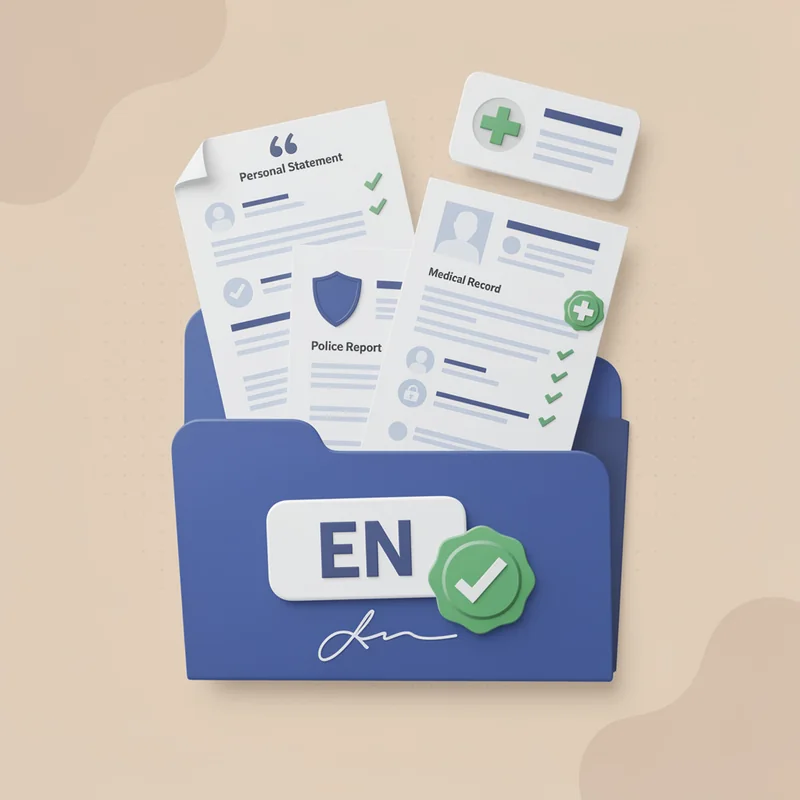
- Certify each document separately, so a police report, a medical record and a screenshot each stand as a complete exhibit.
- Screenshots of threats are translated in full, including sender names, timestamps and your own replies; profanity is rendered literally with a translator's note where needed.
- If you submit an article or a post, submit and translate the whole article or post with its source and date; a translated paragraph without context is not a translation of a document.
- Give your translator one list of Latin spellings for every name and place in the file, and send all documents in one batch.
What asylum evidence looks like in practice
An asylum application on Form I-589 rests on your own account, and the documents you attach are there to support it. For applicants from Russia and Ukraine those documents tend to fall into a few groups: written statements from relatives, friends and colleagues; police reports, summonses and court papers; medical records and hospital discharge summaries; threats received by message, email or social media; and news articles or online posts about you, your organization or the events you describe. Almost all of it is in Russian or Ukrainian, and every page you submit must be in English as well.
This guide covers the translation side only: what to translate, how it should be certified, how to handle screenshots and long publications, and how to keep names and dates consistent across dozens of pages. It does not cover legal strategy; that is a question for your attorney or accredited representative.
Two rules, one standard
If your case is before USCIS, the rule is 8 CFR 103.2(b)(3): any foreign-language document must come with a full English translation, and the translator must certify in writing that the translation is complete and accurate and that they are competent to translate. If your case is before an immigration judge, the court's own rule at 8 CFR 1003.33 says the same thing in slightly different words: a foreign-language document must be accompanied by an English translation and a certification signed by the translator.
Both rules apply to every item, not to the packet as a whole. A single certification stapled to the front of fifty pages does not tell the reader which pages were translated by whom. We attach a signed certificate of accuracy to each document, so a police report, a medical record and a screenshot each arrive as their own complete exhibit: the English text, the certification and a copy of the original in one PDF.
Declarations and witness statements
A statement written in Russian or Ukrainian by a relative, a former colleague or a neighbor is evidence exactly as written. Your translator renders it in full, including the heading, the date, the place, the signature line and any note about who wrote it and how it was sent. Nothing is tidied up. If the writer repeats themselves or uses an odd phrase, the English keeps it, because the officer or the judge is reading for what the witness said, not for style.
Handwritten statements deserve extra care. Ask the writer to print clearly or to type the statement and sign it; if a word is genuinely unreadable, your translator marks it as illegible in square brackets rather than guessing. If a statement quotes a threat or an insult word for word, the translation quotes it word for word too, with a short translator's note where a term has no direct English equivalent.
Police reports, summonses and medical records
Official documents from Russia and Ukraine follow set forms, and the details in those forms are what make them readable as evidence: the case or entry number, the name and rank of the officer, the article of the code cited, the date and the stamp of the issuing office. Your translator carries every one of those details into English exactly as they appear, keeps article numbers in their original form, and translates the text of each stamp and seal.
Medical records bring their own difficulties: abbreviations, diagnosis codes, doctors' handwriting and forms printed in one language and filled in another. A discharge summary from a hospital in Kharkiv or a certificate from a trauma clinic in Moscow is translated in full, with codes reproduced as written and abbreviations expanded where the meaning is clear and marked where it is not.
- Police certificate or report: number, date, issuing unit, officer, cited articles, stamp.
- Court summons or decision: case number, court name, judge, dates, ruling text, seal.
- Medical record: institution, dates of treatment, diagnosis, treatment, signing physician, stamp.
- Certificate from an employer, school or organization: letterhead, registration numbers, signatory, seal.
Threats, messages and screenshots
Messages in Telegram, WhatsApp, VKontakte or by SMS are usually submitted as screenshots. A screenshot is a document like any other: it must be translated in full, and that includes the sender's name or handle, the date and time stamps, the text of every visible message and any visible replies from you. Cropping out your own replies makes the exchange harder to read, so capture the whole conversation and let the translation reflect it.
Threatening language is translated literally. Profanity and slurs are rendered with their closest English equivalent, and your translator adds a note where the original carries a meaning that a plain English word does not. Emojis and stickers are described in brackets. If the messages span many screens, number the screenshots in order before you send them, so the exhibit and the translation follow the same sequence.
News clippings, posts and the question of partial translations
Applicants often ask whether they can translate only the paragraph that mentions them. The rules ask for a complete translation of the document you submit, so the practical answer is to define the document carefully. If you submit one article from a newspaper or a website, submit the whole article, together with the masthead or the page header that shows the publication name and date, and translate all of that. If you submit a single social media post, submit the post with its author, date and visible reaction counts, and translate all of it.
What you should not do is send a ten-page article with two sentences translated and the rest left in Russian, or paste a paragraph without any indication of where it came from. If a long publication really is the document, and only part of it is relevant, talk to your attorney about submitting the full original with a full translation, or about whether a shorter source would serve the same purpose. When we translate an excerpt at your request, the translation is labeled as an excerpt, and the certificate states exactly which pages or paragraphs were translated, so nobody can mistake it for a translation of the whole.
Consistency across the whole file
An asylum file can run to hundreds of pages, and inconsistency is what makes a reader stop. The same person should be spelled the same way in the declaration, the police report and the translation of the message thread. The same town should have one English name throughout, and dates should follow one format.
- 1Write down the Latin spelling of every name in your file, starting with your own as in your passport and on Form I-589, and give that list to your translator.
- 2Decide on one English form for place names, following current official usage for Ukraine (Kyiv, Kharkiv, Odesa) and the spelling in your passport for your own place of birth.
- 3Send all documents to one translator, or at least in one batch, so that the terminology is handled the same way throughout.
- 4Number your exhibits and ask for the translations to carry the same numbers.
- 5Keep every original. Translations accompany originals; they do not replace them.
We translate asylum evidence from Russian and Ukrainian from $23.70 per document, certification included for every item. Upload what you have, tell us the case is for asylum, and your translator will flag anything that looks incomplete, such as a screenshot with a cut-off date or a report missing its stamp page, before the work starts.
FAQ
Do I need a separate certification for each document in an asylum file?
Each document should stand on its own, with its own translation and its own signed certification. That is how we deliver them: one PDF per document, containing the English text, the certificate of accuracy and a copy of the original. A single certification for a whole packet leaves it unclear which pages were translated by whom.
Can you translate handwritten statements and messy medical notes?
Yes. Handwritten Russian and Ukrainian are everyday work for your translator. Where a word is unreadable, it is marked as illegible in brackets instead of being guessed, and abbreviations are expanded only where the meaning is clear. A sharp photo in good light makes the difference; see our guide on photographing documents.
Do I really have to translate the whole newspaper?
No, only the document you submit. If that is one article, submit the full article with the page header showing the publication name and date, and translate all of it. If you decide with your attorney to submit only an excerpt, we label the translation as an excerpt and state in the certificate exactly which parts were translated.
If you need your documents translated, always work with a certified translator.
POVO translates Russian and Ukrainian documents into English, with a signed certificate of accuracy. Upload the document, see the price and the date, pay when you are ready.